Tag: awake

  • Idealism and Moral Justice

    We all have an idealism of some sort. It might be too harsh or too soft. It all really boils down to our temperament and how we view the world. In an isekai, it is often achieved through vigilante justice because often times isekai villains are either too influential or are already above the law. Injustice is rampant, and there would be oppressed or belittled races. Morality kind of goes out the window. No longer is it about trying to do what’s right; rather, it is about power struggles and trying to access political or social status. Yuusha or heroes would often level up or gain absurd powers, then swoop in and defeat the enemies. This story setup sparks something inside of us that makes it so satisfying to watch or continue on with a series. It is in all of us to want to take control of a situation and do what we think is right, call it a compass of some sort. The usual trope of the weak character becoming strong, we like to identify ourselves with someone powerless, that works hard and achieves things through hard work and resilience, then stumbling upon a superpower or a “cheat skill” that somehow makes the hero journey more bearable.

    We yearn for that kind of world, a world where we somehow can make a difference, trying to defeat Demon Lords and gaining control over our situation and lives. This genre of anime is often an alternative escape, similar to what MMORPG once was, trying to play out a role wherein you have more control. What kind of role would you play if you have more control? Would you be the righteous judge who considers all things before making a decision? Would you prefer to be the vigilante, who instantly seeks us justice for those who can’t? We all have an ideal world. What kind of world is ideal for you? What kind of E-Sekai would you want to have?
  • What is Peace for You?

    Peace is a very sought-after thing. I think it is fair to say that everybody wants peace.
    Throughout history, there were different ways that “peace” was achieved. Take, for example, power struggles or cold wars. There are different factions that create a “stalemate” to avoid the risk of mass destruction or even complete annihilation.
    When presented with the option to go against an immovable force or a bigger opponent. What is it that you do? Do you instead create small skirmishes that try to destabilize or just conserve energy and try to negotiate your position? The issue comes when the intention is to dominate or overwhelm the other. Now, take for instance Subaru from Re:Zero. He has the option to just go back and redo all the mistakes that were done. Now, we do not consider the implications and future impacts of war. What matters is the immediate results of what we want. The problem is war of attrition. Now, wars last at most hundreds of years. With the rise of more modern warfare and powerful weapons, it usually just lasts a couple of years.

    Peace can be acquired once we know what exactly we are fighting for and are willing to give up and surrender that. When we ask ourselves, is it really worth it? Winning something now and losing in the long run? It could have been that an alliance is formed. It could even be that we lose a lifelong agreement over such trivial matters. What is it that we are fighting for? What is it that you want to achieve? Now, in this E-Sekai world, peace is commonplace because in that world, we can take out from a magic bag infinite amounts of whatever it is that we need. Technology and power can be achieved by divine blessing and opportunity, and everyone is living purposefully. What is peace for you? Aren’t we all after peace that surpasses all understanding? Well, I could at least offer you a peaceful retreat from all the seriousness of this world.

  • What Power Would You Want In an E-Sekai

    The God has spoken, you can have any power in this new world. What would you want?
    A magic pocket that you can pull anything at any time? A library of knowledge that you can learn anything and everything from?
    The power to control elements? The power to foresee the future?
    Interestingly, this question is something that I got myself asking. I mean, I could ask for anything, right?
    You could provide a full description of your capabilities, like a DnD character lore.
    Honestly, I have never played DnD, but I assume that if you created a character without downsides, that it wouldn’t be fun, right?
    A perfect character that has a counter for everything, then that wouldn’t make a balance game, right?
    When is it apt to be content and wanting to strive for more?
    I think adaptability is one of the best powers we can have. As time passes, we want to be able to mold our environment to adjust to levels and create a process of redistribution. This can create a balance that would make the experience fun and fresh.
    I think that the striving for more can only happen if the environment encourages and creates space for improvement. Contentment only happens when struggling does not create fruit, which makes the entire endeavor meaningless.
    When coming into an isekai, the general trope is for the main character to be overpowered. This essentially makes side characters almost irrelevant apart from adding flavor and color to the main character’s story. While the MC can essentially run the show himself, we often find him/her encountering characters either by choice or by chance. Generally, evolving or growing characters make the story more colorful and create a more balanced world. So while being overpowered seems the ideal choice at first, having other people join in creates a more unique and bright story line.

  • Trusting People In A Different Environment

    Who do we trust in times of untruths and unknown unknowns? In a world of E-Sekai, we would come across different ways of interpreting things. When conversations are straightforward, then it is easy to get an answer, but if we want unhindered truth, we often find ourselves walking on eggshells? Why is that? Experiences are truths; no one could ever dispute what you have experienced in your life. However, there are certain things that go beyond our experiences. Discovering truths of the world is like discovering magic in another world; it’s like discovering gravity or the knowledge of how the world operates. Much like when we find a new discovery, we celebrate, we promote, and rejoice in the thing that we uncovered. Trust is like that; when we get to know something about someone, we rejoice and feel special, and the same is true with that person. What if that discovery or special game is now shared with another? Is it still yours? Would the value of the relationship collapse? Not really… because the value of anything is based on the appraiser. Relationships that are built on trust rather than power dynamics are stronger, since there really aren’t any expectations from a trust relationship, which is similar to a pact. Think of it like a child’s relationship with a parent; if it is just output or outcome-based, then surely the child has little to no benefit for the parent. We take care of the other anyway, just because the value of the child isn’t solely based on its output, and that is ultimately subjective.
    The topic of trust is based on a lot of aspects; we create a space where trust is safe for mutual parties, where even though we say or do something, they won’t take offense; rather, it would be taken as a collaborative ideal, which helps create something positive. Trust is very sensitive, especially for things that are outside our control; it acts like a bank of some sorts; when something is overdrawn, then we demand that trust is reciprocated. The topic in itself is getting out of hand, but let me leave you with a good thought: trusting people in a different environment can be hard, but so long as we can get a common ground on things, I believe that there are always ways to talk things through and gain mutual respect and perspective.

  • Making Sense of the Pareto Principle

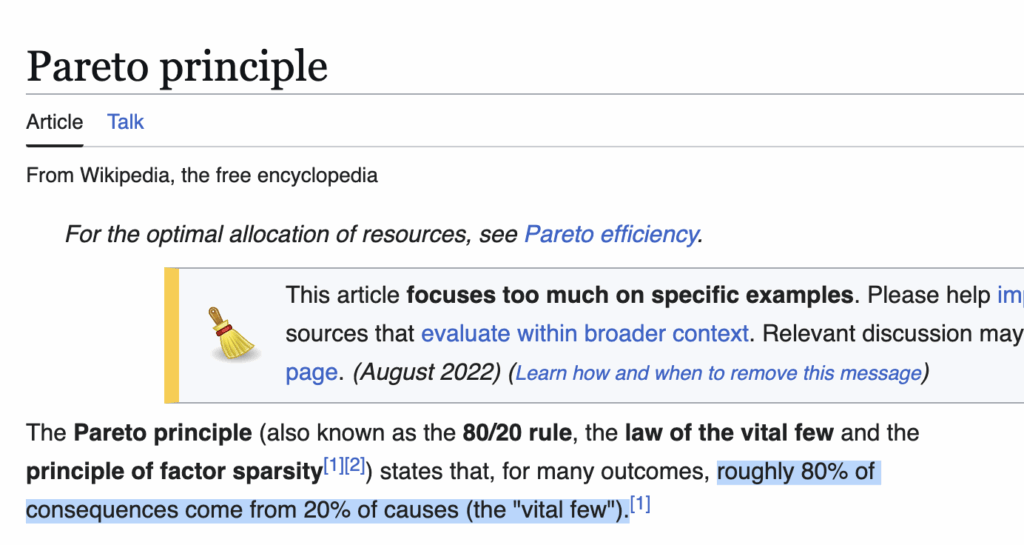
    The Pareto Principle, the 80/20 rule, where 20% owns 80% of the wealth. The idea in itself was supposedly applicable in other areas like efficiency, where 80% of the output comes from 20% of the workers.

    While this is applicable to certain scenarios, using it as a catch all can be detrimental. My though about this is, in this world we were meant to serve each other and the higher up we are in the chain, then we have a bigger role to play. To be called “vital” should not be self serving rather it should serve the interest of the people. The world really isn’t in an ideal place right now, arguably people shift things towards their advantage. In this world, certain things are needed in order to move things properly and accordingly, this hurts because often times the interest of one view does not justify the interest of other another’s view. This is similar to what I wrote about earlier in the “Trolley Problem“. The “vital few” often times need to take care of the own tribe first which can be contradicting to the bigger picture. Power and control also play a part, because often we can be persuaded by different things depending on the situation that we are in.

    What happens if we are on the other side of the Pareto principle. Do we just stay still and wait until the 20% dictates what should be done? Maybe yes, if we believe in them even if it complicates all the things in our lives. Maybe no, if we want to move on our own way. In life there are certain boundaries, and we don’t necessarily have the means to cross those boundaries, I mean chance happens to all of us after-all. I think what matters is what we do with what we have, it doesn’t mean we don’t try to broaden our horizons, rather it just means that we hold on to the 20% so that we could better serve the 80%.

  • Believing in Magic and the Supernatural

    If you saw something magical/out of this world and failed to capture it either with video or camera. How do you share it with others? What if it is just a situation like a small drop of rain out of no where, when there is no drizzle or no other source of water in sight. What if God suddenly wants juice while speaking Italian. Outrageous as it may seem certain things cannot be put into words without sounding cuckoo. While thinking about it, I figured you either need to talk with someone wanting to humor you, has a certain level of knowledge or interest in the matter, or have a certain degree of relationship or trust.

    It is almost impossible to believe given how things are now. Logic will counter magic any time. There are a lot of ways to do that, like straw-manning. Maybe humoring someone and sticking out until you know someone well enough is the only way to believe. Yet that is still not true, since what they say might not fall the same way for that person or certain situations could cause them to sway towards the opposing view. It is easy to discredit someone about magic, just say its natural and be done with right? Once we know everything about something then there is nothing to it anymore, no mystery and nothing to talk about. It becomes stale and not interesting anymore. Life can be like that sometimes, once you see all the things that life has to offer then there is nothing to it anymore right. Magic can only happen when we willingly go through the process with little to no expectation. It creates space for the spirit of the unknown to move. Instead of us all moving in different directions. Believing in magic is like being a child that is still at home, trusting in everything that their parent says. Until we step out and see the real things behind those stories. What do we then if we get hold of the truth? Do we then use that magic to reveal or do we keep it at the back of our minds that way the magic isn’t loss?

    Magic is something that was hard for me to believe in. Until we see incredible supernatural things, we settle on the shallow parts of magic without getting to the truth behind it. Yes, innocence plays a part but tricky part is remaining to be innocent while knowing the truth behind it all.

  • Waiting When There Is Nothing

    When you get presented the option on Shrodinger’s cat scenario would you assume that the cat is alive? Control is deprived from us and delegated to the “experimenter”. What if you were in the cat’s position on the experiment, in this case your life is in the hands of two different people, one a cold judge and the other a person that is completely detached from what happens to you.

    Another test is the cookie experiment, here the kids are given a cookie in front of them and the scientist suddenly needs to go somewhere and requests the child to hold off from taking a bite from the cookie. If you were in the child’s shoes, would you wait or would you eat the cookie.

    In both scenarios, there is no clear reward. Our only basis for what to do is what the scientist told us or their “authority”. That is hard for anyone, because we do not like giving up control, our view is often limited to something that is tangible, something that we want in the moment. Yet we are still given much freedom in those scenarios, we can roam around the room, we can rest or other we can find something else to pass the time. The focus doesn’t necessarily need to be on the actual experiment rather we can just do different things so long as we are within certain bounds. Given that on the first thought our choices are dictated by another, would you rebel and choose to not be part of the test? or would you trust that what ever happens it would turn out for the best for you.

    I think that certain things require trust especially on 50/50 scenarios when we are given little to no choice. Cliche as it may seem, it would always be good to not focus on the problem but rather what we have control on. Maybe we end up getting punished or rewarded, and there might not be a good solution to it. In the end, we are still subject to this weird experiment and while others might not agree with me, I think it is best to keep lane and make sure we don’t mess up the “work” that they are doing.

  • A Deciding Factor

    When looking back in the past, we can always see the frame from a wider view. How things were set in motion because of an action and what we could have done better, what things we can do to improve the current situation. This allows us to make the right decisions and help us to stay grounded since we could not fully grasp the all the possible trajectory of each person. We can only estimate things if a person has unlimited options, thus if we want to come up with a concise decision then we must limit its uses. Think in terms of Subaru if he gets limited in one path, on the next revival he chooses a different path, choice is what makes us different from animals, we can always pivot towards another path that is not hindered nor limited. Everything comes at a cost and we must never discount the source of anything because it eventually boils down to one thing anyway. So when deciding on things, we must take into consideration all the factors that are involved, people affected by our decisions, effects of our decisions across time and how it affects the environment that we are currently in. Unfortunately, we have limited scope and view of our world. We can only control what is immediately in front of us and the things within our grasp in our short lifespan, I think we should consider things that helped us get this far and which things we should retain in order to move along the right direction.

  • Reflections and Renewal

    A new world requires a recount of the old one. If we have not experienced the old then we wouldn’t know what we want with the new. A child is disciplined when we don’t confirm to what is “correct” behavior, however who was it that defined the correct behavior. Why would we act in a certain way when we don’t have rules in place for our actions. In our world today, often times it is society that dictates what is acceptable and what is not. Comparing it to the old days, we have become more liberated and less concerned with judgement. “I have done nothing wrong”, “What I do does not affect anybody” or “everyone else is doing it” are common ways of thinking nowadays. Completely disregarding past norms, since they had little no benefit anyway. Bending and breaking rules, testing the limits of our new found freedom in order to be “yourself”. Innately, nothing wrong with that right? Having individuality makes us unique and experience is the best teacher after all.

    Our standards suddenly become miles apart from what we previously had. Was is it really all for free, I mean did we not lose anything in the transition towards this “new world”? Like shifting from black and white to colored, new seems to be much better than the old. Often times it is, since I am not typing on a typewriter rather on a laptop computer. This is true for technology, but is it also true for other things? What did we lose in order to get to where we are. Is it really negligible. In all honestly, I don’t know or maybe I fail to see what I am missing. Maybe all the advancements and the know how somehow overshadow what is sacrificed, or is it that we just fail to notice it because it is too mundane and nuanced.

  • The Bright View in a Dark Room

    It is a common anime trope to have a dense character in the midst of all the chaos, completely oblivious while still staying positive. This humorous parallel is often true both ways, we can either be super positive of a situation or super negative about a situation. A toxic positive attitude can disqualify what others are experiencing and prevent them from opening up and sharing problems and struggles they currently have. On the other hand if we view things too negatively then we can’t share successes and celebrate growth. Words are a reflection of the speaker, thus we learn to take in anything and digest it in order to bring life onto our words.

    Recognition of someone’s situation and their truth helps bring out authenticity and prepares us to plant the right thoughts that could bring out the best in people. Situations does not define a person’s capability to respond properly rather it creates an opportunity to learn to control what we say and do. Grips on reality helps us not fall into the stereotype of the above trope, rather it helps our higher self flow freely which stabilizes our emotions and reactions.